James Saker is part of the senior leadership group and head of digital marketing at Ocado Retail, the 50:50 joint venture between Marks & Spencer and Ocado Group. With 15 years of experience in marketing and media, he’s driven growth for both domestic and international brands.
With over 1.2 million customers, Ocado Retail is the world’s largest dedicated online supermarket. However, we operate in a hyper-competitive market where staying ahead requires continuous innovation — not just in logistics and technology, but also in how we connect with and acquire new customers.
Recent external factors have added significant pressure to this. Among them are increasing competition from on-demand delivery services, alongside established grocers with different operating models, who pick items from their stores as opposed to warehouses. And then there’s that ever-present economic buzzword: inflation.
But ultimately, we’re a growth business. Our mission is to deliver Ocado’s unbeatable range, unrivalled service and reassuringly good value to many more households across the U.K. every week with our fleet of iconic purple vans.
Hungry for growth
We knew we had to level up our marketing mix to deliver our ambitious growth plans. We needed to diversify our channels to reach new audiences and drive brand consideration while meeting cost-effective customer acquisition targets. The “what got us here, won't get us there” philosophy became our driving force.
For years, we had a successful customer acquisition model built on established channels. As we scaled, however, we saw a challenge. The cost to acquire new customers was rising while the growth rate from these channels was plateauing.
To continue growing, we couldn't just spend more. We had to find an entirely new and scalable growth engine. Ultimately, we decided to diversify our channel mix by bringing YouTube on board, and then optimised it to best suit our needs.
To continue growing, we couldn't just spend more. We had to find an entirely new and scalable growth engine.
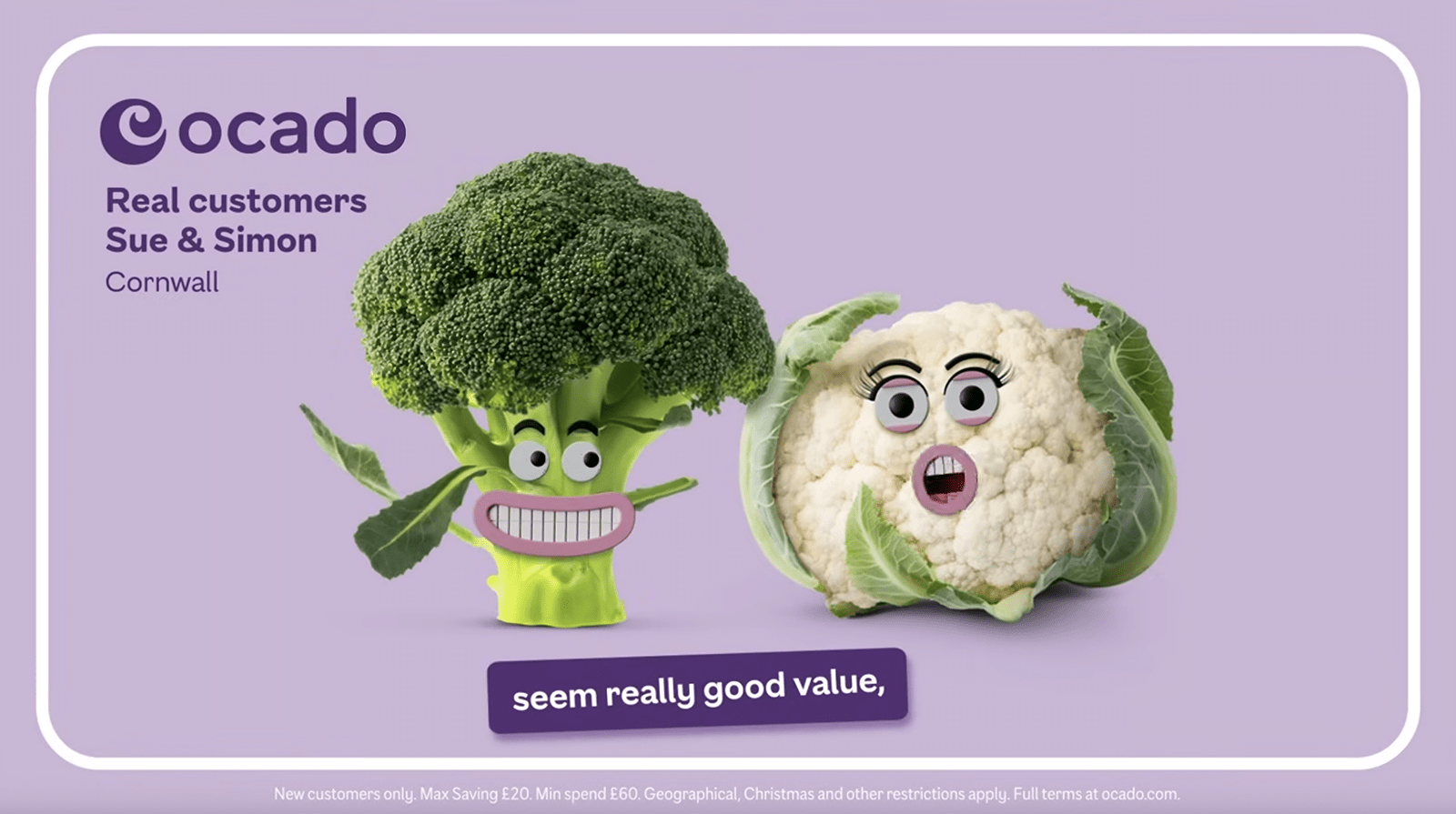
Boxing it up — Ocado’s new approach to video
The core of our new approach was high-quality, actionable video. We wanted YouTube to become a way to reach an entirely new customer base.
To optimise the opportunity in this ‘new pond', our team developed a range of videos tailored for performance. We incorporated elements like integrated product feeds to make them more engaging and drive conversion.
In a rethink of our YouTube strategy, we made the crucial decision to shift away from running campaigns in short, targeted bursts, to an ‘always-on’ marketing approach. Prior to then, our approach had been to ‘pulse’ YouTube. That means we would run a campaign only around a seasonal moment, such as Valentine's Day or Christmas. After doing this for just a few months, the ‘always-on’ approach had proved so successful, we haven’t turned it off since.
But this wasn't just about changing the timing, it was about creating a constant stream of learning. By being continuously active in-market, we could test creative, messaging, and audiences in real-time, and generate both data and insights much faster.
For example, we discovered that specific upper funnel audience personas (like “cycling enthusiasts”' or “green living enthusiasts”) overindexed with Ocado. When we started including them in our audience strategy we saw stronger performance. We also anchored the voiceover with text, which we refer to as “showing and telling”, which provided a similar boost.
To optimise for new customer transactions, we used Demand Gen, which is a long-term, education-focused marketing strategy that prioritises reaching and engaging “out of market” buyers. Specifically by:
- Regularly analysing creative performance and refreshing content with new concepts and seasonal messaging.
- Adding product feed extensions and audience features to re-engage users who had previously interacted with our ads. This included optimised targeting, lookalike segments (engaging with users like the ones who previously engaged with Ocado), and YouTube audiences (audiences determined by the platform, e.g. “homeowners”).
Out for delivery — measuring the business impact
Once the new approach was up and running, we needed to measure its true business impact.
We used Google data-driven attribution (DDA) to optimise short-term performance, analysed conversion path reports to adjust to conversion windows, and used lift studies to track incrementality and calibrate long-term performance in our marketing mix modelling (MMM).
MMM is a data analysis technique that uses statistical models to measure the impact of various marketing and advertising activities on our key performance indicators, such as sales. Our MMM model, which the results feed into, means we’re able to understand the ROI across different media.
It also allows us to see the ROI of different tactics within channels, like YouTube branding solutions, like Video View Campaigns, vs. YouTube Performance solutions, like Demand Gen. We then use this, calibrated with rigorous lift studies, to validate our decisions and give us the confidence to invest strategically in this new video strategy.
David Murray-Jones, YouTube for action lead at Google U.K., worked with us on these efforts. He said: ”I don't think we have other clients that combine such an advanced creative and measurement approach, in particular the combination of measurement sources.”.
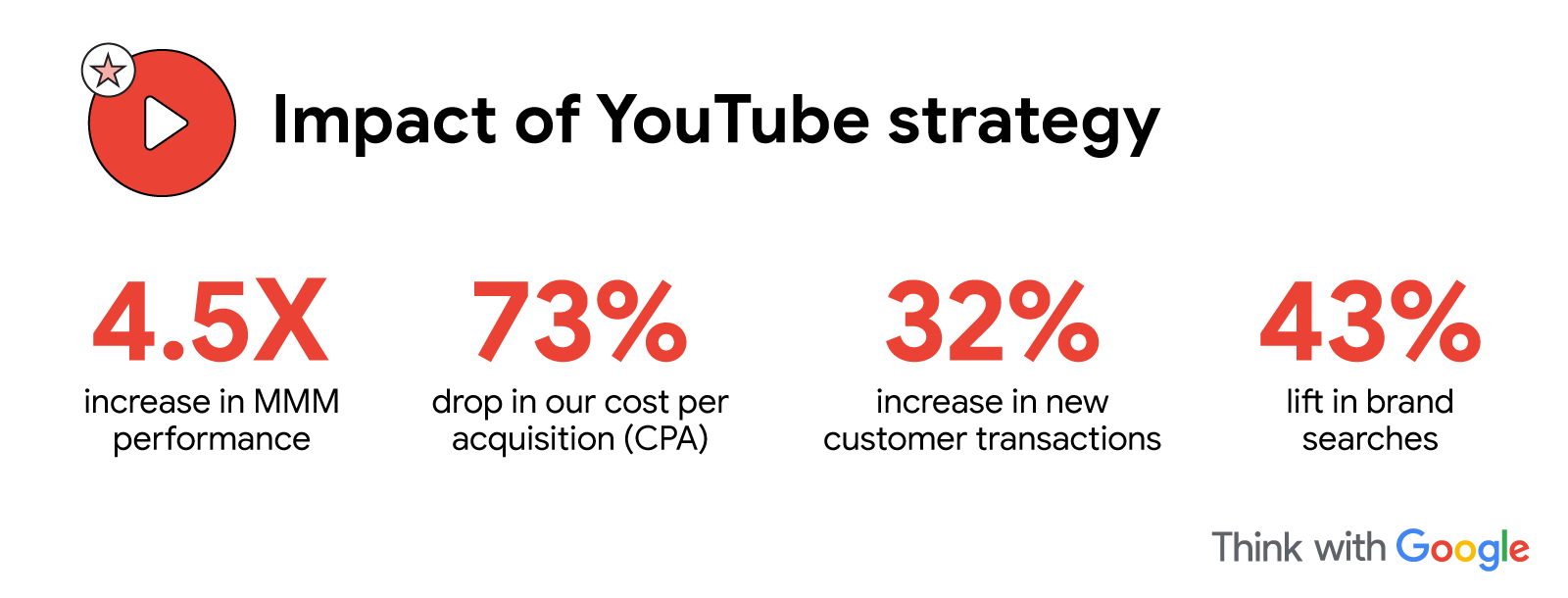
The results from this strategic shift — which included a 32% increase in new customer transactions, and a 43% lift in brand searches — were phenomenal and fundamentally changed our business. Year-on-year, this data-backed approach yielded:
But perhaps the biggest win has been our ability to drive direct conversions for a high-consideration purchase. To achieve this, we switched from volume of acquisition bidding to return on ad spend-based bidding.
After all, a “big shop” isn't an impulse buy. Yet by changing the bidding process like this, we found a way to drive thousands of new customer orders through YouTube every single week. We didn’t just hit our targets, we shattered them!
The road ahead for the Ocado fleet
This always-on data-driven approach is no longer just a concept we’re testing. It’s now an integral part of our YouTube strategy and the high-quality, highly-convertible videos we produce on that channel. Not only do we have a scalable and efficient customer acquisition pipeline — we are making a real and measurable impact on our bottom line.
Going forward, we will build on this foundation by using our test-and-learn methodology to further refine our creative and targeting. We want to unlock even greater performance that always delivers — just like we do.